Thursday, 22 September 2011

Slam Tilt (1996/Amiga)

Liquid Dezign was a group that was born from the Digital Illusions group that made pinball games in the early 90s. That brand had punched out the first of 21st Century Entertainment’s series of pinball games. 1992’s Pinball Dreams was a great little number for the time, but looked dated, flat, gaudy and simplistic after only a few years, with one of the four tables featuring a music chart theme that beggars belief. Later in the same year came Pinball Fantasies, also with four tables, which played and looked about the same, unsurprisingly. Pinball Illusions came along in 1995 and brushed up the graphics a bit, but 21st Century decided to call on Spidersoft to produce Pinball Mania in the same, which was diabolical.

At this point, pinball madness had almost run its course. The same tables began appearing in multi-pack compilation after compilation and saw a lot of porting. 1996’s Slam Tilt stands out as the last memorable standalone pinball game of the time. The PC port a year later featured different menu screens but was very much the same game. Sure enough, its four tables would go on to be lumped in with compilations just like the rest of them. As a package, it really stands out. From the icy metal patterned box to the audio, graphics and gameplay, Slam Tilt puts the works of Digital Illusions to shame. Supposedly the last first-release to get a review published in an issue of the Amiga Power magazine that scored 90% or better, it was put out into an Amiga scene in its death throes, Commodore having declared bankruptcy years earlier. Nevertheless, it’s a polished effort that deserved to be ported to the PC.

The sound is very crisp and clear, with a lot of urgent twists to the music when you’re on specific tasks. There was no overhaul in the sound department on the port, and it’s not hard to see why. The game makes the audio of the Digital Illusions titles sound like cheap one armed bandit machine noises that you find in tacky arcades and Sonic The Hedgehog games. I half expected Michael Jackson’s “Thriller” to be playing faintly in the background with Pinball Dreams. Why is “Thriller” the same song that gets stuck on in a permanent loop in those places anyway? As a man perpetually stuck in the past, even I find these outdated tips uncomfortably obsolete.

The bold claim on the box that Slam
Tilt
 is "The Pinball Game" is just a
description, and they like to remind
you of what you're about to play
The menu screen is a little bland,
but that's the biggest complaint
you'll have about the game, and it
was changed for the PC port
The graphics are something else. So it’s 2D, who cares? The 3D games don’t fare any better, and the camera panning and zooming here is spot on. Rather than focusing all their attention on creating the shiniest ball you’ve ever seen (I can almost see my reflection in the balls used in Pinball Illusions), they work on everything else. The rails and ramps look better, the backboards are painted in well, and the flashing lights have great shading. Then there’s the faux-LCD display at the top. Sure, it tells you your score and how many balls you’ve used, but there’s much more to it. Animations from the amusing to the creepy punctuate the game modes just as well as the sound does, and there’s even a minigame or two on each table where you go interactive with it.

The LCD screen plays host to fun
little side games like "throw knives
at silhouettes armed with cannons"
The gameplay is simple (it’s pinball, after all) but sickeningly addictive. The ball zips around at a good rate, never trapped for too long. The targets aren’t especially challenging to hit, so you always feel like you’re ready to amass a heavy score once you’ve either sussed the table out or read the manual. You’re more prone to losing the ball down the middle or down the side lanes than in other games, so you often find yourself thwarted and driven to have another go. It’s a frustrating way to get addicted to a game, but it really works. The lights are clear indicators of where to shoot, so picking up what you have to do is pretty easy. On the rare occasion that you get a minigame that enables the video, it’s either so self-explanatory that it requires no thought (shoot the thing with this moving reticle) or instructions flash up if more than one button is required (flippers to steer, launch to shoot, or flippers to button-mash). I wouldn’t say it adds a whole other dimension, but this is a good thing, and these games are fun little sideshows rather than making Slam Tilt something other than a pinball experience.

Mean Machines - a nice easy start
The four tables that are featured are largely excellent. “Mean Machines” will likely be the one that you play first. It’s first on the list and the easiest to put down a big score on. It’s a good table, but arguably the weakest. It looks overcrowded, has a weird “overheat” function which doesn’t do anything but annoy you, and is probably the most regurgitated theme in pinball computer game history. With the bad points out of the way, its numerous positives include its easiness as a beginner table, vast ramps, a third flipper with more than one option available, and the same benefits that every table here has: amusing twists on the theme (chicken races, stock car smash ups), lots of different modes to unlock, and fast and exciting gameplay.
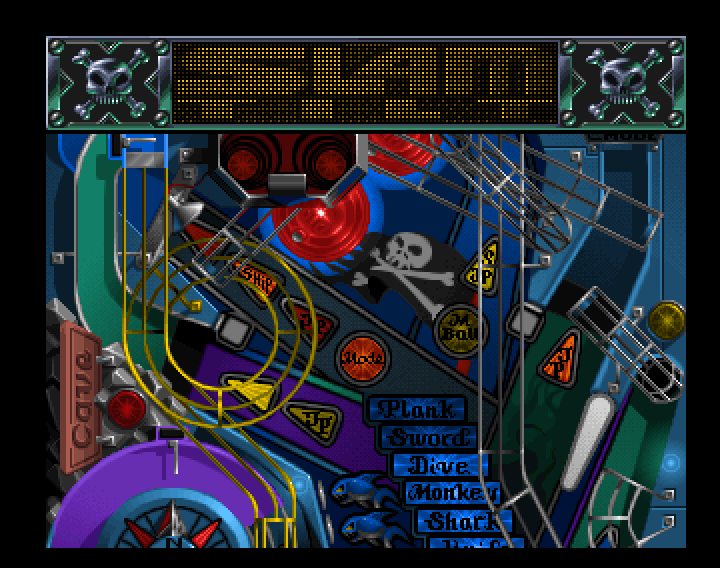
The Pirate - a fine yarrrdstick for all
computer pinball games to compare to
The second table, “The Pirate” is the only table that really differs from the standard in terms of themes (cars, space and spookiness are all common tender), and offers something different to the other tables as well. Rather than losing a top corner to “fill the three flashing lights to get a bonus upgrade”, it has a funky “magna table” random bonus box thingy, and a much greater emphasis is placed on multiball games. Multiball is a function on every table, but it’s at its best here, and while the music on this table is particularly good, nothing beats the hilarious background music for the “Crocedile” [sic] multiball. The modes are fun, the table is a little more challenging, and it isn’t too crowded, so there’s plenty of room for a giant compass and a cave thingy. The table runs smooth as silk, and is my personal pick.

Ace Of Space - right up there
with the best of them
A close runner up is “Ace Of Space”, which runs a little slower, but makes up for it with some of the best game modes out there. From the predictable “Space Race” to the interactive “Death Planet” (the best video minigame on offer) to the ridiculous “Blam” (shooting ramps to destroy random targets such as a UFO, space station, a banana, the monkey from “The Pirate”, a space cow… wait, what?), there’s a full range of shenanigans for everyone. It’s well packed without being cluttered, and if it wasn’t for the slightly slower pace and the pointless zigzag in that left hand rail that shouldn’t exist, this would be a very serious challenger to “The Pirate”.

Night Of The Demon - this table
is horrifically hard to dominate
The final table is the much tougher “Night Of The Demon”. The ramps are harder to shoot, and it’s noticeably sparse. While it’s slightly less playable than the other tables, the twisted and silly humour prevalent in the other tables comes into full bloom beneath the creepy veneer of this morbid theme. The relative lack of modes and options (the only table without a third flipper is the one that could really have used one along with a couple of extra ramps) do make this table suffer compared to the last two, but its difficulty does appeal to the more hardened pinball veteran.

The multiball feature can get a
bit overwhelming at these speeds
The camera pans well, so you
always know what's going on
It’s not big and it’s not clever, but Slam Tilt hits the sweet spot. Not overambitious on the number of tables, the Liquid Dezign crew from Sweden put a lot of work into the industry standard of four tables, and the results are great. Decades on, the game doesn’t look remotely dated, and if you can play it, it’s as good as any modern pinball game out there. Colourful and intense, you don’t find yourself sitting around for too long waiting for your balls to drop. Even the high scores present good, challenging strata. Without setting yourself harsh restrictions, Slam Tilt will decimate your free time.

Sunday, 11 September 2011

Beneath A Steel Sky (1994/Amiga/PC)


One of the more exotic gaming journeys back into the 90s was to indulge in a point-and-click adventure that wasn’t a LucasArts project, but one that could stand tall against just about any of them. One well-recognised game that matches these criteria is found in the trip back to early 1994, with the destination being an uncomfortable chair in front of a DOS machine with Beneath A Steel Sky ready to play. I first experienced this game as a youngster on the Amiga, but revisiting and playing through the PC “talkie” version brought extra life to the set. The CD-ROM is also slightly harder to use as a murder weapon than the Amiga’s colossal fifteen floppy disks, which resemble a hefty brickbat when taped together and wrapped in something brickbat-coloured, or fifteen highly customised shurikens.

It’s not without its flaws, the most notable being the ill-fitting American accents of Foster and a minority of the cast, and indeed the entire cast bar Eduardo the gardener if you consider that the game is played in Australia, with the rest of the cast displaying a broad array of British accents, among others. Still, the cockneys are close enough. The voice acting has the right amount of ham to blend in with the dialogue to bring humorous overtones to a conceptually sinister game, similar in theory but not in practice to the cream of LucasArts’ contributions to the genre. The background music is typically supplementary, and the moods usually complement the intended atmospheres, but it is a little bit too cheery at times. The Virtual Theatre engine propels non-playable characters around the world, but the need to avoid them at times and to be moved to a particular place on the screen to have a conversation can be grating.

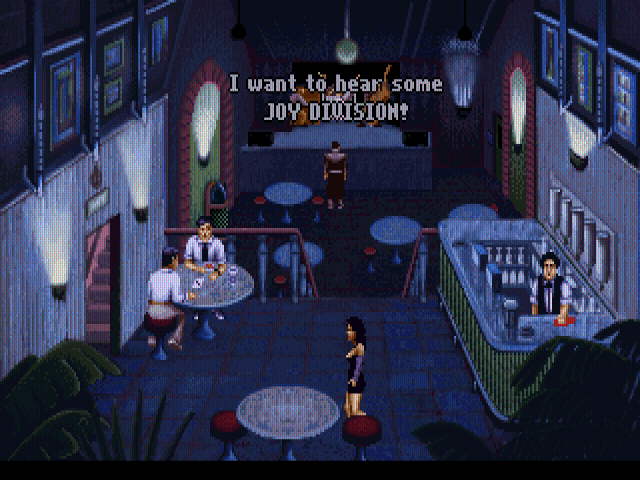
You play Robert Foster. He's stylish...
...an effortless womaniser...
...has a refined taste in music...
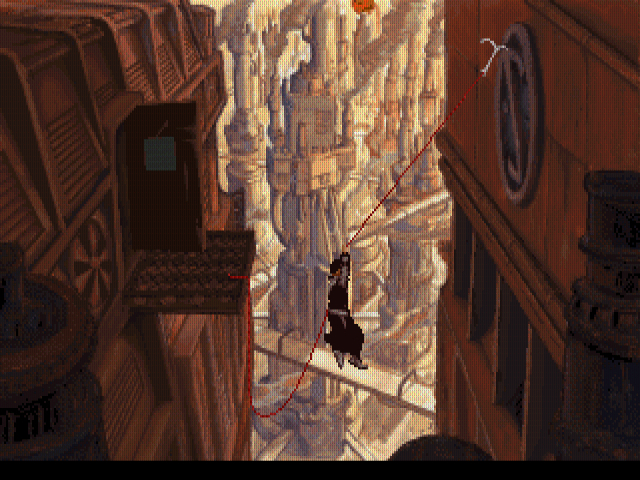
...and is quite the athlete, to boot!
The characters are typically very identifiable despite not having discernable faces. This is largely due to the scope of accents deployed, and while it’s something you wince at upon the realisation that you’re getting a vocal tour of the British Isles (London, Birmingham, Cardiff, Belfast, Liverpool, Manchester and Edinburgh are all covered, although 1994 was long before non-footballers from Newcastle were allowed to become celebrities on a regular basis, and the treaty that controversially decreed that Geordie was technically a dialect of English only came into force a decade later), you do start to appreciate the necessity of this as you get further into the game. The primary layer of characters is quite distinctive, with the free outsider Foster, the zealous Reich, the archaic Lamb, the rebellious Anita, and the caustic mechanoid Joey. There are a lot of characters, however, that fit into the oblivious, selfish stereotype, but you still manage to maintain a mental image of them through their often unique voice, which is never subtle but not always a caricature. The French doorman’s accent is a little forced, but it’s more David Suchet’s Hercule Poirot than Peter Sellers’ Jacques Clouseau, so we’re not treated to the sheer mockery of the tongue seen in Jackie Chan Stuntmaster and other games. On the other hand, the Welsh security guard is practically drowning in saliva as he stumbles through lines like “We’re here to serve the community, and shoot people” (which, despite being epitomic of Beneath A Steel Sky, is far too easily missed), and Sam and Norville in the security centre are so brummie that they make Jasper Carrott sound like a foreign national.

Joey is always complaining...
...and Hobbins can see why...
...but that's what upgrades are for
The nagging issue that the characters don’t always stick to the written script is largely the cause of dialect, and this is in evidence as the American Foster meanders loosely around a very colloquial British script, with “jumper”, “it’s well smart”, and “they’re shagged beyond repair” changed to “sweater”, “it’s totally cool”, and “they’re frazzed beyond repair”. You can feel the defiance in the voice actor in the last of those lines. “‘Shagged’? Don’t be ridiculous, frazzed makes much more sense,” he says to himself. He’s wrong, though.

The most intensive the interface
gets, and it's telling you why
Hobbins is in such poor shape
Being point-and-click, it’s hard to complain about the controls. You click either mouse button to walk somewhere, talk to someone, or follow an exit cursor, and you left-click to examine a highlighted object, right-click to pick up or interact with it, and right-click anywhere to skip a line of text. Just one keyboard button is required, to bring up the menu. The interface is dead simple. The unobtrusive inventory only drops down if you move the cursor to the very top, and the only thing that changes when looking at objects is the cursor, which changes from a smaller arrow to a larger one labelled “Exit” for a route out of the room, or to a crosshairs with the name of the object or person, which even changes as the player learns the character’s name. It’s all minimal and effective, and allows you to enjoy the graphics.

Stunning graphics are featured...
...from the barren to the exotic
And what graphics they are. The background art supplied by illustrious comic book artist Dave Gibbons is painted to a half-realism rather than his comic style, although he does provide a comic strip too for the introduction in the packaging, which was featured at the beginning of the game itself on CD-ROM. From the bleak industrial towers to the plush modern veneers, the artwork is something to be savoured, and you can easily appreciate the effort that the Revolution team put into giving it centre stage. You even have the option to remove speech text from view if you’re feeling cocky about hearing everything first time, but do bear in mind that you don’t get to repeat conversations.

Lifts make transportation easy
Despite the sprawling city and plot, the navigable world is pretty small. Multiply that with the ability to change your game speeds, and you’ve got a much more easily accessible world than say, The Secret Of Monkey Island, a comparably epic world that takes about four decades to explore.

Right from the almost-animated cartoon strip intro, the scavengers that act as the guardians of Robert Foster paint an ill landscape erupting into the sky, and the protagonist’s life summary illustrates the relative wasteland. Another helicopter crash brings Foster, now regarded as a fugitive, to the start of the gameplay. Unlike a fair chunk of its peers, Beneath A Steel Sky presents several situations where our protagonist can die, and the ability to save is most welcome. Points of timing also come up, and the ability to slow the game speed down can prove to be quite nifty at times.

Foster gets backed up against a
wall straight away, and can die here...
...good thing he's so eloquent and
can blag his way out of trouble
You’re instantly put in a situation where Foster can be killed. Walking down the stairs results in instant termination courtesy of the purple clad guard. A simple puzzle leads to a very dead end, but Foster manages to outwit the goon without your help. As the guard leaves the building, your next step is to find a shell for Joey, who can then analyse your items, mend things, break things, fly, complain, and insult you. After convincing the hapless Howard Hobbins that he’s a safety inspector, which becomes his recurring disguise, he steals his stuff and slides down into the recycling plant’s furnace room. Upon attempting to escape the room, gun-toting security officer Stephen Reich (who was in charge of abducting Foster in the intro) bursts in, pointing his weapon at Foster, who as it turns out, is Robert Overmann, but he’s still Foster to us. Some spy camera linked to a system called LINC toasts Reich, and the pun-toting fugitive is becoming aware that someone or something is looking out his survival.

Foster's incisive humour is nothing
short of irresistable...
...he's smooth like ice, but Lamb is
cold to the touch and isn't very nice

Dystopian fashion is questionable,
and yet Foster's coat is ridiculed
The supporting caste bears the
brunt of swingeing cuts
Having looted Reich’s corpse, Foster can access most of the industrial area available to him after this point, waving his imaginary inspector credentials around like a feather duster to any guards and technicians that he chooses to talk to. There are computer terminals that he can use his newfound card on, through which he eventually discovers that this LINC thing had his mother killed. In the pipe factory, Foster meets the suffering rogue Anita Einbeck, who is sympathetic to Foster’s plight, and her oppressive, ostentatious supervisor Gilbert Lamb, who is implied to be some sort of inept hack. After trying to flirt with Anita, discovering that he’s in Union City (Sydney, apparently), learning that this city is a supposed corporation which is at economic war with Hobart (another city/corporation that isn’t renamed), and sabotaging the power plant, Foster fixes the lift and gains access to Belle Vue, home to a couple of characters, and several strange businesses.

Suddenly, you're in what feels
like a different world
Belle Vue isn't paradise, but it
sure beats London
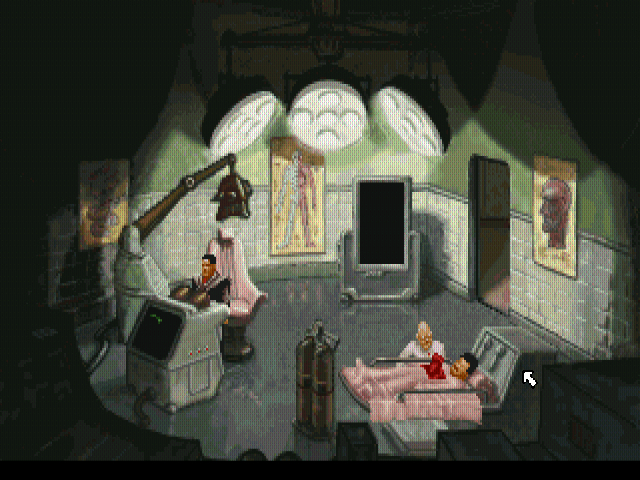
The strange but admittedly not counterintuitive concept of being closer to the ground giving you higher status that Foster had picked up on is in full view here. The rusting housing of industry gives way to stone facades and plant life. Belle Vue isn’t brilliantly lush, but it’s such a stark contrast, particularly outside the conveniently adjacent living quarters of Reich and Lamb, where you can talk to a strange chap called Gallagher, who thinks he’s… William Shatner. Foster can visit the travel agency, insurance company, and the obligatory mad scientist Doctor Burke, replete with a curious German accent and a habit of inhaling anaesthetic whilst cutting up patients, who provides Foster with an electronic port in his head (not shown). Foster can then access LINC (“LINCspace”), which is like some bizarre virtual reality world with a set of puzzles.

LINCspace is like stepping
into another game
With enough trickery and help from Anita, Foster gets to Hyde Park at ground level, and manages to get some answers from Danielle Piermont, whose deceased husband’s work led the pair of them to be close to the Overmann family. The frightening Piermont is incredibly wealthy and well connected, and can get you access to an underground club, and her dog Spunky can be used to create a good distraction for one Officer Blunt, who is basically Parker from Thunderbirds, who ‘as no h’idea what h’exactly you’re h’up to. After entering a truly bizarre courthouse scene in which a dated judge presides over his court as if it were a game show, Hobbins hastily befriends Foster after standing accused of assaulting Blunt with some water spray, which was an unseen result of Foster’s work in the power plant.

Very good, m'lady:
h'Officer Blunt h'is 'opeless
Here's your starter for ten:
Judge Chutney hosts a sham court
Doctor Burke is definitely
on something
After discovering Anita’s radiation-cooked body in the cathedral, an increasingly vengeful Foster vows to finish what Anita was planning, and destroy LINC. He sneaks into the underground to find some of the strangest things imaginable in the circumstances. LINC is a pulsating organism hooked up to Foster’s dad, and some guy with a surfer dude voice is totally growing rubbery androids. Joey, whose job is to annoy you and keep breaking shells, has his last one broken after an altercation with the mysterious Gallagher, who turns out to be... another android, and Foster downloads him into an android and dubs him Ken. A few more puzzles and sharp thinking leads to Foster meeting his father, and then on to victory. Fast forward a little spring cleaning, and everything's fantastic, so Foster declares his return to the gap, despite all of his tribe having been exterminated in the explosion courtesy of Reich’s entourage in the introduction, leaving Ken and Hobbins behind. The fate of the rest of the surviving citizens of the implied nicer, uncorrupted Union City is left open, apart from Lamb, who is suggested to get a return to work in a less prestigious position. End game, roll credits, “be vigilant”, whoopee.

Things get weirder by the minute
Some of the puzzles are easier than others. Along with the threat of death that isn’t always obvious, some puzzles are abstractly different to others, which keeps you on your toes at all times. While many hallmarks of adventure games are there, such as the initial level acting as a silent tutorial that equates to “use that metal thing to open that metal door or get shot”, and the increasing complexity, moving around LINCspace makes you feel like you’re playing a different game.

The plot is heartwrenchingly good
Beneath A Steel Sky is a killer game
Dizzying heights were achieved
in the creation of this game
The game is completely gripping, and while a huge part of it is because of the amazing art, challenging gameplay and intriguing plot, a fair chunk is down to uncomfortable juxtapositions. From the way LINCspace feels compared to the tangible walkways, and how oddly cheery Belle Vue and Hyde Park are compared to the rest of the world, to the strange hodgepodge of current and dated technology that the dystopia setting allows for, and the strands of humour woven into such a serious tapestry, you're always wanting to play more just to achieve a greater sense of clarity. While The Secret Of Monkey Island and LeChuck’s Revenge were conceived from a grim idea that was crafted to be brimming with charm, the use of humour in Beneath A Steel Sky added a dimension to the game rather than just changing it to a different type. By straddling the borders of multiple concepts rather than firmly establishing the game as something distinct, the folks at Revolution risked a game that would fall flat and not achieve in any category. However, they put the work in, and served up something that, while not quite perfect, overachieved in many ways. Beneath A Steel Sky is one of the pinnacles of the genre, and its release to the freeware world in 2003 and inexpensive remastered release as a sort of iApp thingy in 2009 by the company, which was a demonstration that they understood the emulator scene and disaffected consumers better than the bigger players, have helped to keep the flame of adventure games alive. It is inspiring gamers to dig back into the past and indulge in the classic games, and encouraging developers to dedicate their time to creating games for the so-called unfashionable genre. Its place as both a quality game and a historically significant package are in no doubt.

Sunday, 28 August 2011

Jackie Chan Stuntmaster (2000/PS1)

Remember all those cheesy Jackie Chan movies that were as much martial arts as they were slapstick? He’s usually either a government official of sorts or an everyman who gets in a tangle with some sort of crime syndicate which is easily unravelled because their kung fu is weak, and they’re not ruthless enough to take Jackie’s character down when he’s having a silly moment.

Jackie Chan Stuntmaster has our man playing himself, but as a delivery boy for his grumpy grandfather’s company. An advanced crime syndicate kidnaps the grandfather and a package that Jackie was supposed to be responsible for. Jackie is understandably distressed for the state of his grandfather, who is bizarrely more interested in the wellbeing of the package than himself. A cutscene leads Jackie to a central point where he must unlock levels by, astonishingly, kung fu fighting his way through a line of henchmen, and area bosses whose role is to make your progress more difficult, and to confuse the already whimsical plot, in which the crime lord (a Chinaman called Dante with a British accent) proclaims that he committed these crimes because he just could. After all, what place is there for a boxer dressed as a clown and a disco-dancing throwback in a modern criminal organisation?

The main hub is where you start the
game, can practice your moves, and
access all areas from
You start your search in Chinatown,
where you immediately bounce around
collecting dragons and health boosts
Zat eez goeeng to 'eurt in ze morneeng.
Zees keed eez tougheur zan 'e looks!
The waterfront is the second section,
dominated by Frenchmen and Indians
The voice acting, aside from featuring our star, incorporates all of our favourite gripes that the critics loathe so. The accents, most prominent of which are French, British (common and posh London), and the Bronx sound, are outrageously overdone, and of course, the main antagonist has a British accent. The one-liners during the fighting are predictably cheesy puns and dated humour, with Jackie’s notoriously tenuous grip on English vowel emphasis somewhat exaggerated. The narrow script gets more evident as you progress through the game, as all the bad guys have the same lines regardless of accent, such as “what did I ever do to you?”, “I give up”, and “I want to be on your side” whilst trying to beat you up. Of course, the line “my bruises got bruises” is one of many lines comically distorted by Inspector Clouseau French dockworkers into “mah broo-zezz got broo-zezz”. The background music is inconsistent, sometimes lively, game-enhancing funk and percussion, other times drab atmospherics for a whole level, but overall they’ve done a good job.

Does this look like Jackie Chan to
you? With that shading, he bears a
closer resemblance to Adolf Hitler
While the plot, script and voice acting are below par to deliberately generate the feel of a cheesy Jackie Chan film, the graphics don’t really have that excuse. Despite having supposedly scanned Jackie’s face in, the main character’s face is devoid of resemblance, almost featureless, and all the characters are very blocky. Maybe the facial thing was because they were trying to make the protagonist look younger (who was in his mid 40s at the time), and the lower polygon count would have helped to reduce what is a noticeably long loading time from a point of unbearable tardiness. Luckily, this is mostly forgotten in the gameplay. In true Jackie Chan style, you can have him pulling unsuspecting weapons out of the scenery (which fares better graphically) from the plausible to the preposterous. Anything goes from pool cues, exhaust pipes, and frying pans, to the likes of giant fish, potted plants, and (in the bonus level) candlesticks. Even the victory credits knock off his films, with staged outtakes throughout. Not being real, the FMV scenes (where the graphic deficiencies of the character suffer the most throughout the game) see our hero go through a couple of trademark outtakes, but also walk away from what would have been some quite debilitating injuries, and the canned laughter at these moments is marginally disturbing.

Jackie has a swinging time, and he
needs to swing, wall jump, roll around,
and time well to get himself through
increasingly treacherous levels
Jackie's transfer arrives on time in the
sewer, the third section being one of
the majority that includes dodging bad
guys and obstacles whilst on a ride
A trio of ninjas attempt to get the
jump on you in the rooftop section,
the fourth of these unrelated areas
Jackie boogies on down like your
uncle, with a result of the mercurial
Random Nemesis Generator
The controls are pretty reasonable, and you can get some nifty combo moves out of the punch and kick buttons, and this also applies to objects that Jackie picks up. However, as the game goes on, you’ll find yourself relying on specific moves. Dive-rolling into a punch or kick is only countered by some of the area bosses and the white-clad ninjas on occasion, enabling you to roll in, knock your opponent down, get lots of fighting points, roll away before he gets up, and keep doing it. Grabbing an opponent is typically followed by throwing them, and as the levels get more dangerous and more ledges are present, the value of this becomes priceless, as you save a lot of health from not having to engage them for very long. It does get to the stage where the improvised weapons aren’t really that useful except for racking up the style points. Your points are worth amassing (although it isn’t that hard to do, because you tend to fight everyone by necessity, many doors won't open until you've conquered the room), because at the end of each level you’re assessed and awarded extra “takes” with good grades. The takes instead of lives is consistent with the film knockoff effect, but also the blood-free comedy element of the game, which pretty much implies that nearly everyone’s knocked out rather than killed. It’s a lot like watching The A-Team television series with George Peppard and company, only Jackie Chan doesn’t have a gun, and could probably shoot more accurately and drive more convincingly than that supposed crack commando unit if given the chance.

Jackie dances with danger on
the wrong side of the tracks
The gameplay is good fun. There’s a decent range of fighting moves available from the limited button arrangement that allows the game scope to give you some action puzzles and the means to ferret around for goodies. The means to dodge giant fans and swinging pianos, and to discover objects such as red dragons, extra takes, and health healing items (which are rice, milk and noodles, because this game is ridiculous) are a nice condiment rather than an overpowering stench for the most part that mixes up the constant fighting nicely. The only real exceptions are the factory levels where you’re about fifty times more likely to die from a hazard than being beaten up. Jackie’s a slick fighter, being able to knock opponents up into the air and hit them about five times as they mysteriously float gently to the ground. He can run up walls and backflip kick people, sweep kick, jump kick (this move is almost always likely to lead into Jackie being struck mid-move, but he can pull it off occasionally), stun punch, flip over people and throw them in the opposite direction, do wall jumps, strafing, and more. He’s not so clever when he’s running, though. With the running motion they’ve given him, it looks like he should be moving much faster than he actually does, but at least he isn’t the protagonist from Hitman: Contracts who spends most of his time skating across concrete. The difficulty level is a little on the easy side for a while but does build up at a good pace, which is just as well because it’s not adjustable.

Something's a bit fishy about Jackie's
choice of weapons sometimes, but
using them brings extra points
Take a leaf out of the expert's book
and send your opponent reeling,
just like in his films

Jackie Chan is no stranger to
carelessness-related injury, especially
in the factory, the fifth and final area
The game save is a little bit frustrating. One block on a PS1 memory card is fine, but you can only have one save per memory card. Because the gameplay isn’t strictly linear (you can revisit any completed level), you could say that it’s not all that important. However, there comes a point when the difficulty of the game dictates that you lose more takes than you gain, and you start weighing up whether you have enough takes in the bank to be okay with losing several takes a level, or whether you feel you need to reload and redo that level until you’ve lost a sufficiently low amount of takes because it’s only going to get harder. Allowing for a second block to be created can’t’ve been that much trouble. Given that the saves can only be done in the main hub and you’re always reset to the same standing position, I dare say that there should be room for more than one save in a block. The only data that’s really saved is the number of takes and the levels completed, along with the grades and dragons collected, and the save time is unusually fast for a Playstation game.

You're bound to fall for the charms
of this lovably cheesy game
The likeness to a Jackie Chan
film is stunning
The gameplay is nothing
short of electrifying
Jackie Chan Stuntmaster is a
game that I'm a massive fan of
Everyone loves Jackie Chan. Even if you aren’t taken with his stunts and martial arts, you still won’t be able to resist cracking a smile at his so-amateurishly-bad-that-it’s-better-than-Hollywood slapstick. The folks at Radical Entertainment worked hard to give Jackie Chan Stuntmaster that authentic aroma of pure cheese, and by and large they got it right. It’s easy to pick at flaws, the most notable of which are the character design, inconsistent atmospherics, and the save feature limitations. However, the overall job they’ve done is fantastic. Doubtlessly aided by the actor providing motion capture for his moves, the action is smooth, lively, and addictive, with a mostly excellent balance of action puzzle thrown in to keep your brain switching gears. The humour and plotline makes you cringe but laugh in the same way that the films do. The authenticity, humour and gameplay all hit the mark, and make the game a surprisingly good addition to the scrolling beat ‘em up world, which usually thrives on outright violence and is often best remembered for much older titles, going back to 1991’s Streets Of Rage, 1989’s Final Fight, and 1986’s Renegade as some of the best examples of a genre that remains best defined by rather old seminal titles. Bridging modern appeal with traditional craft, just as Jackie Chan himself did so well, Jackie Chan Stuntmaster was worth every penny, and is still joyously playable to this day.